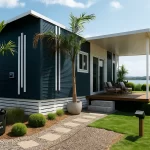
Teeny Tiny Homes explains how tiny home exterior finishes coordinate COLORBOND, Weathertex and merbau for compact homes designed in Caboolture, Queensland.
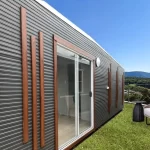
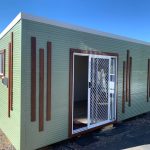
Selecting tiny home exterior finishes is a practical purchasing decision because colour, texture, exposure and upkeep all affect the completed façade. Our published standard inclusions list COLORBOND® roofing and wall cladding, decorative Weathertex timber-look cladding, merbau slats and merbau framing around exterior windows. Coordinating these materials before construction helps create a coherent exterior while keeping each finish in an appropriate visual role.
How Do COLORBOND®, Weathertex and Merbau Work Together?
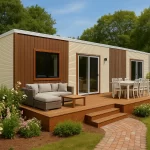
The strongest approach is to give each material a distinct purpose. COLORBOND® can form the dominant roof and wall surfaces, Weathertex can introduce a secondary area of texture, and merbau can provide warmth around windows or through decorative slats.
A compact façade can quickly look crowded when steel, cladding and timber all compete for attention. We recommend keeping one material dominant, using the second to define an entrance or selected wall, and reserving merbau for controlled accents that connect those areas without overwhelming the elevation. On a small home, repeated colour across roofing, gutters and major wall panels can establish visual continuity, while Weathertex and merbau provide depth rather than unrelated feature treatments.
Coordinate Colour and Texture Around Merbau
Merbau has naturally warm yellow-orange to reddish-brown tones, so the surrounding finishes should acknowledge that undertone. Rather than selecting three colours independently, we recommend comparing physical samples together outdoors in direct sun, shade and changing afternoon light.
- Contemporary: Consider charcoal or grey COLORBOND® with warm-neutral Weathertex and natural merbau.
- Light coastal: Consider pale grey or off-white steel with restrained, light-toned cladding.
- Bushland: Muted green-grey or earthy steel can connect the building with vegetation and timber.
- Undertones: Use warm rather than blue whites where they sit directly beside reddish merbau.
- Consistency: Treat roofing, gutters, flashings and wall sheets as one connected palette.
- Availability: Confirm colours, profiles and finishes with our team before treating an inspiration palette as a final specification.
Account for Heat, Exposure and Ongoing Care
Good tiny home exterior finishes must suit the intended site, not merely a colour board. Light roof colours generally absorb less solar heat than dark colours, while coastal exposure can affect the appropriate COLORBOND® product and increase the need to wash sheltered areas with fresh water.
Weathertex maintenance depends on the product supplied. Pre-primed boards need an appropriate exterior topcoat, whereas Natural Weathertex can be stained or allowed to weather; merbau also requires suitable preparation because natural tannins and oils can affect coating performance or mark nearby pale surfaces. Before finalising colours, verify the exact product and coating requirements with us.
Teeny Tiny Homes and Tiny Home Exterior Finishes
A successful exterior specification balances appearance with location, material exposure and realistic maintenance requirements. Teeny Tiny Homes can confirm which exterior selections apply to your selected design and explain how our steel, decorative cladding and timber details relate. Reviewing physical samples together reduces mismatched undertones and provides a clearer basis for approving the final specification.
Contact us to check out the exterior material options for your proposed home at our Caboolture display village.